The same story as the illustrated book, ready for reading aloud, selecting text, or using a screen reader.
In a nest beside the pond, four yellow ducklings hatched. A fifth egg, larger than the others, remained closed.
The four little ones hurried after Mother Duck. She returned to the nest and rested a wing over the egg. “I will wait for you,” she whispered.
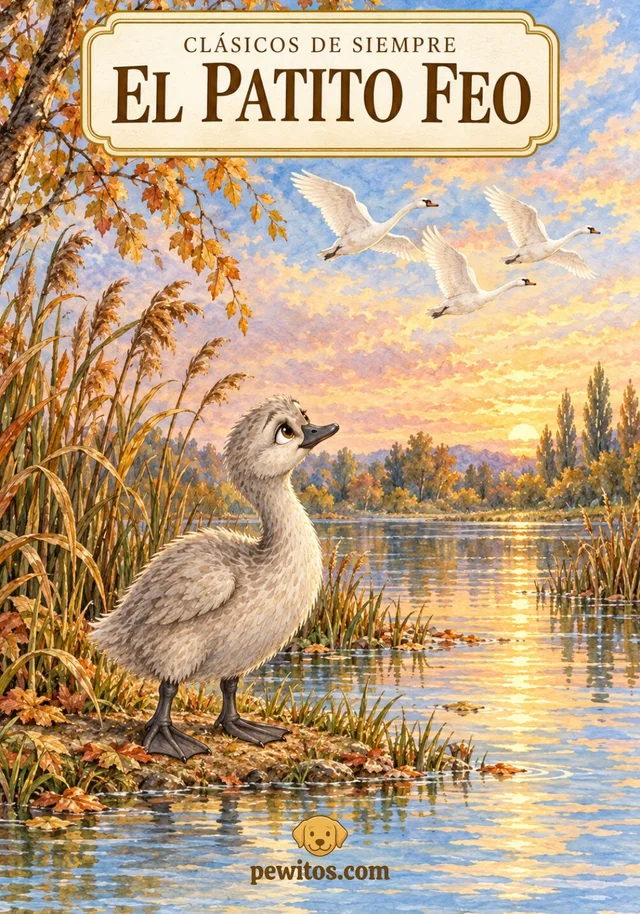
The next day the shell cracked. Out came a gray chick, taller than the others, with enormous feet. He looked at Mother Duck with bright, attentive eyes.
In the water, his big feet helped him. He swam around Mother Duck and splashed with delight. She smiled: her little one knew his way.
In the farmyard, his four siblings teased him about his long neck and big feet. He looked down. Though they stood together, he felt very alone.
Mother Duck sheltered him beneath her wing. “You can swim as well as anyone,” she said. He loved her, but each day it grew harder to leave the nest.
One morning the gray bird slipped through a gap in the fence. “I will find a place where I need not hide,” he thought. He followed the river through the fields.
The river led him to a marsh of tall reeds. No one there asked about his neck or his feet. For the first time in days, he could rest.
Wild birds arrived at dawn. The youngster made room for them at the bank, and they let him stay. They were not friends yet, but they shared the water.
Suddenly a distant noise sounded. The birds took flight. The little one ducked among the reeds; his heart raced, but he spotted a narrow channel.
He paddled quietly through the channel into a small cove. He was safe there, but no one awaited him. He stayed still, listening to the water.
That afternoon three white swans passed over the cove. The youngster raised his head. He had never seen wings so broad or a flight so calm.
He beat his wings to follow. He barely rose above the water and landed with a splash. The swans flew on; he looked at his wings and decided to care for them as they grew.
The afternoons grew shorter. The youngster found a sheltered hollow beneath willow roots and gathered dry reeds. He would have a place to spend the cold nights.
The first frost came. With his big feet he kept a circle of water open beside the willow. The feet he once hid were helping him now.
One night the ice closed the last circle of water. Snow blocked his shelter. The youngster lay still on the snow, too cold to keep swimming.
At dawn a farmer found him. He wrapped the bird carefully in his coat and took him home. Beside the fire, the youngster drank water and began to move his feet again.
The man cared for him through the rest of winter. In spring he opened the door to let him go. The youngster spread his stronger wings, and the air held him.
He reached a garden lake. There were the three swans he had seen in autumn. He approached with a little fear and discovered his reflection in the water: he was a young white swan.
The three swans made room for him. He swam beside them and spread his wings in the sun. He remembered Mother Duck, his big feet and the long journey: he had learned to keep going as himself.