The same story as the illustrated book, ready for reading aloud, selecting text, or using a screen reader.
Long ago, a grandmother washed clothes beside the river while Grandfather gathered firewood. An enormous peach appeared among the ripples. She carried it home to share.
At home, the peach opened by itself. Inside was a smiling baby. The grandparents named him Momotaro, the Peach Boy, and decided to raise him with all their love.
As he grew, Momotaro found Grandfather struggling to lift a large bundle of firewood. He divided it in two, and each carried one. Together they reached home before dark.
One day, Momotaro learned that oni from an island had taken rice, cloth, and tools from the villages. He decided to ask for their return. Grandmother made kibidango, and Grandfather gave him a wooden sword.
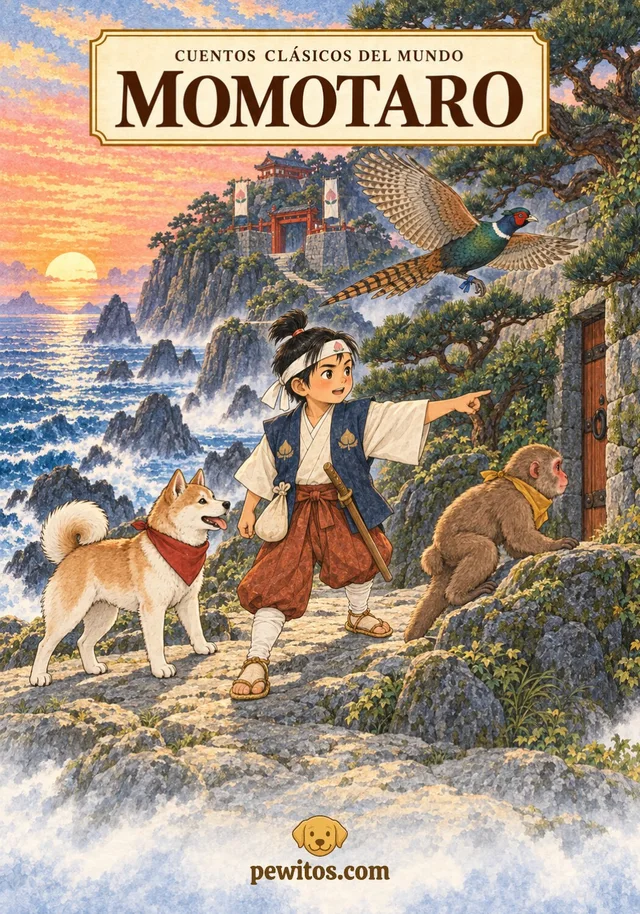
On the road, a hungry dog smelled the kibidango. Momotaro split one and offered it. “I will come with you,” said Dog. Momotaro agreed: he was no longer walking alone.
Farther on, a monkey watched a broken bridge above a stream. Momotaro shared another kibidango. Monkey showed them a crossing among the rocks and joined the journey.
At last a green pheasant appeared. Momotaro shared another kibidango, and the bird joined Dog and Monkey. From a branch he pointed the way to the sea. Now there were four travelers.
At the sea, they boarded a small boat bound for Onigashima. They made a plan: Pheasant would watch from the air, Monkey would climb, Dog would guard the entrance, and Momotaro would speak with the chief.
The wind shifted suddenly, and the boat tipped. Dog crouched to steady it, Monkey secured a rope, and Pheasant spotted calm water beyond some rocks. Momotaro followed the route Pheasant showed him.
From above, Pheasant spotted a small opening in the side wall, hidden behind a pine. He flew back to tell them. Momotaro turned away from the great gate: that side entrance could let them approach unnoticed.
Monkey climbed to the opening and lifted the side gate's latch. Dog held the gate open. Momotaro followed them inside. Each friend opened the way for the next.
Three oni waited in the courtyard. “We have come for the things you took,” said Momotaro, keeping his wooden sword low. “Please return them.” The blue chief gripped his club and blocked the storehouse.
The chief slammed the storehouse door. The other oni stepped forward with their clubs. Momotaro backed away without striking anyone and called to his friends: he needed to open the storehouse without hurting anyone.
Pheasant beat his wings, and the oni looked up. Monkey pulled a rope; Dog moved a fallen club aside. Momotaro opened the storehouse. Inside were chests and bundles marked with the villages' names.
They could no longer hide what they had taken. The oni chief lowered his club, and the other two laid theirs on the ground. “We surrender. We will return everything,” he promised. Momotaro accepted and shared the last kibidango.
The chief gathered the chests and asked the other oni to find each village’s bundles. Momotaro read the marks and sorted rice, cloth, and tools. Their promise was beginning to take shape.
They loaded the boat carefully. The water rose close to its rim. Monkey arranged the bundles, Dog stayed still at the bow, and Pheasant guided Momotaro toward the coast.
In the village, the grandparents helped return every bundle. Momotaro embraced his family and said, “We arrived together. Every friend did their part.”
At dusk, Grandmother made more kibidango. Momotaro set one aside for Dog, another for Monkey, and crumbs for Pheasant. They shared the table while the road outside lay quiet.