Pewitos.com
← Back to library

Ages 5-7

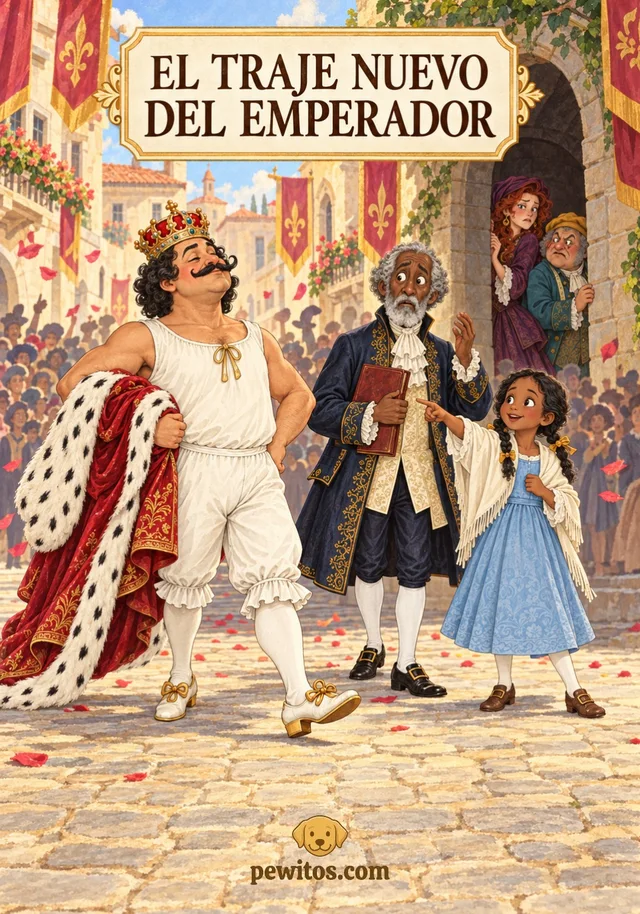
The Emperor’s New Clothes

Two swindlers deceive an entire court until a girl says aloud what everyone can see. A gentle, lucid satire about honesty, independent thought, and the courage to speak the truth.

Hans Christian Andersen · Adapted by Pewitos

Read text Reading guide Download PDF Download to print

A booklet with 2 pages per side: print double-sided flipping on the short edge, fold the stack in half, and staple along the fold.

Age
Ages 5-7
Pages
14
Estimated minutes
5

The story in text

The same story as the illustrated book, ready for reading aloud, selecting text, or using a screen reader.

There was an emperor who thought more about his clothes than the affairs of the kingdom. He changed outfits several times a day and always asked, “Isn’t what I am wearing magnificent?”

Two swindlers came to the palace pretending to be weavers. “We make a marvelous cloth,” they said. “It is invisible to anyone who is foolish or unworthy of office.”

The emperor paid them gold and gave them a hall with two looms. The swindlers moved empty shuttles and requested silk and golden thread, which they hid in their chests.

The minister went to inspect the work. He saw nothing, but feared losing his position. “What a fine pattern!” he exclaimed. Then he repeated to the emperor everything the false weavers had invented.

The emperor himself visited the loom. He could not see the cloth either. Because he did not want to seem foolish, he smiled and said, “It is exactly the suit I want for the grand procession.”

On the festival day, the swindlers pretended to cut and sew. They acted as if they dressed the emperor, then fled with the gold. Before the mirror, no one dared tell the truth.

The emperor walked out beneath a great canopy. The courtiers pretended to hold a train that did not exist, and the people applauded for fear of seeming foolish.

Then the braided girl looked closely and said, “But the emperor is not wearing any new suit!” Her voice was clear and meant no harm: she was simply saying what she saw.

The truth passed from person to person until the whole square repeated it. The emperor’s cheeks grew warm: he understood that he had been deceived and that his fear had helped the deception.

He held his head high and finished the short route, but back at the palace he gathered his ministers. “From today on, I want honest advice, even when I dislike it,” he said. And the kingdom learned that truth needs no elegant suit.


Questions and activities for this story

Pewitos · Reading together

A guide to this story

The false weavers do not need magical cloth: they use each person’s fear of seeming unfit for their job. The girl breaks the silence by describing what she sees. In this edition, the emperor ends by asking his ministers for honest advice.

Before reading

The humor comes from a nonexistent outfit and public embarrassment. Discuss the deception without making someone’s body or appearance a joke. Admitting that you do not know something can be a brave response.

Questions to explore together

  • What threat is hidden inside the weavers’ promise about the cloth?
  • Does the minister describe what he sees or repeat what he is told? Find the scene.
  • Why is the same truth easier to repeat after the girl speaks?
  • What could the emperor do to show that he really wants honest advice?

I saw, I heard, I assumed · 10 minutes

  1. Make three columns with these headings.
  2. Choose the minister and sort what he knows about the supposed outfit. Leave a column empty if there is no evidence.
  3. Write a question that could have helped the emperor check the work before handing over more silk and golden thread.

Words from the story

Weavers
People who make cloth. The visitors pretend to have this skill.
Loom
A tool used for weaving. The palace looms have no cloth on them.
Procession
A group moving along a route for a ceremony. The emperor shows his supposed outfit during one.

About this edition

An adaptation of Andersen’s 1837 tale. A girl says what she sees, and the emperor ends by asking for honest advice. The guide distinguishes observing, repeating and assuming.

Editing and reading guide: Pewitos. Ages and reading times are suggestions; preview the story for your reader.

Suggest a correction or tell us how reading went

Share this story

Hans Christian Andersen · Adapted by Pewitos

Read next