Pewitos.com
← Back to library

Ages 5-7

The Fox and the Crow

A crow holds a piece of cheese in his beak, and a fox tries to win it with flattery. A fable about thinking carefully before believing everything we hear.

Fable attributed to Aesop · Adapted by Pewitos

Read text Reading guide Download PDF Download to print

A booklet with 2 pages per side: print double-sided flipping on the short edge, fold the stack in half, and staple along the fold.

Age
Ages 5-7
Pages
14
Estimated minutes
5

The story in text

The same story as the illustrated book, ready for reading aloud, selecting text, or using a screen reader.

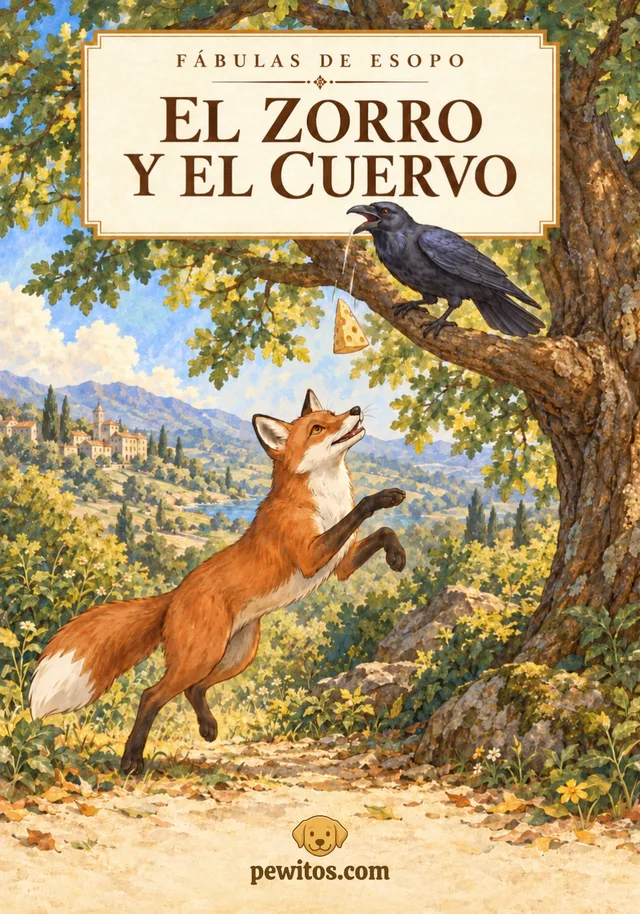
A crow found a piece of cheese and flew to a tree to eat in peace. He settled on a high branch and held the cheese firmly in his beak.

A fox came along the path. When he smelled the cheese, he lifted his nose and spotted the crow among the leaves. He stayed beneath the tree, thinking of a way to get that tasty bite.

"Good morning, Mr. Crow," said the fox. "What beautiful feathers you have!" The crow looked down from the branch but kept his beak closed. He did not want to drop his cheese.

The fox walked around the trunk. "Your feathers shine like the night," he went on. "I have never seen such an elegant bird." The crow straightened his neck, feeling very pleased.

The cheese was still in the crow's beak, and the fox was still hungry. Then he smiled and added, "I'm sure your voice is as lovely as your feathers. Would you sing a song for me?"

The crow imagined himself singing for the whole forest. For a moment he forgot the cheese, lifted his head, and opened his beak wide. "Caw, caw!"

As soon as he opened his beak, the cheese fell from the branch. The fox leaped up and caught it before it touched the ground. It all happened in an instant.

The crow stared at his empty beak. The fox moved away from the tree with the cheese. "Thank you for the song," he said. "Though really, all I wanted was your food."

The crow understood the trick. He had believed every compliment because he liked being admired. He lowered his head and decided to be more careful next time.

From that day on, the crow took his time listening to compliments. Before believing them, he asked himself what the speaker wanted. And whenever he carried food, he kept his beak firmly shut.


Questions and activities for this story

Pewitos · Reading together

A guide to this story

The reader knows the fox wants the cheese before the crow discovers the trick. That difference helps us examine the compliments. Enjoying praise is not the problem; the important detail is the request attached to it and who benefits from agreeing.

Before reading

The crow loses his food but is not physically hurt. Avoid treating trust as a fault or blaming him for being deceived. The fox chooses to manipulate; the crow can learn to take time before deciding.

Questions to explore together

  • What does the fox want before he starts speaking?
  • Which sentences are compliments, and which one is a request?
  • Why does singing make the crow lose the cheese?
  • How could he enjoy the compliment without doing what the fox asks?

A compliment and a request · 10 minutes

  1. Write or draw two speech bubbles: one for a compliment and one for the fox’s request.
  2. Invent a reply that gives the crow time to think or finish eating.
  3. Retell the scene with that reply. Compare what changes for both characters.

Words from the story

Feathers
The covering of a bird’s body. The fox praises the crow’s appearance.
Compliment
Words praising something about someone. Here the praise helps the fox ask for a song.
Trick
An action meant to deceive. The fox pretends to want music while planning to take food.

About this edition

In this version of the fable attributed to Aesop, the reader knows the fox’s intention before the crow does. The guide uses that difference to distinguish praise from a self-serving request.

Editing and reading guide: Pewitos. Ages and reading times are suggestions; preview the story for your reader.

Suggest a correction or tell us how reading went

Share this story

Fable attributed to Aesop · Adapted by Pewitos

Read next