The same story as the illustrated book, ready for reading aloud, selecting text, or using a screen reader.
In a village of long winters, an elderly shoemaker worked with his elderly wife in a small workshop.
He cut and stitched the leather; she kept the accounts and repaired every loose seam. Together they cared for the craft that fed them.
But weeks came with no orders. The neighbors passed by, and the shelves slowly emptied. The couple sold everything they could spare, yet they still opened the workshop each morning.
One afternoon, the wife counted their last coins on the table. They were barely enough for leather for a single pair. “It will be our finest work,” said the shoemaker. “If someone buys it, we can begin again.”
The shoemaker measured twice and cut only once. His hands used every corner of the leather until all the pieces were ready. When the last light faded from the window, they still needed stitching.
“Tomorrow I will stitch them with a rested mind,” he said. He covered the pieces with a cloth, lined up the awl and hammer, and swept the last scraps from the bench.
Before going upstairs to sleep, his wife took his hand. “Whatever tomorrow brings, we will face it together.” They put out the lamp, closed the door, and the workshop fell silent.
At dawn, the cloth was folded, and a finished pair of shoes shone on the table. The stitches were so small and strong that the shoemaker searched for a faulty seam and could not find one.
That same day, a customer examined the shoes and paid a good price for them. With those coins, the couple could buy leather for two pairs. For the first time in many weeks, they returned home with light steps.
That night they left two pairs cut out. The next morning, all four shoes were finished. It happened again, and each sale added a little to the shelves, the pantry, and the couple's spirits.
“I want to know who is helping us,” said his wife. “Not to stop them, but to say thank you.” The shoemaker nodded. They decided to watch the workshop on a very cold night.
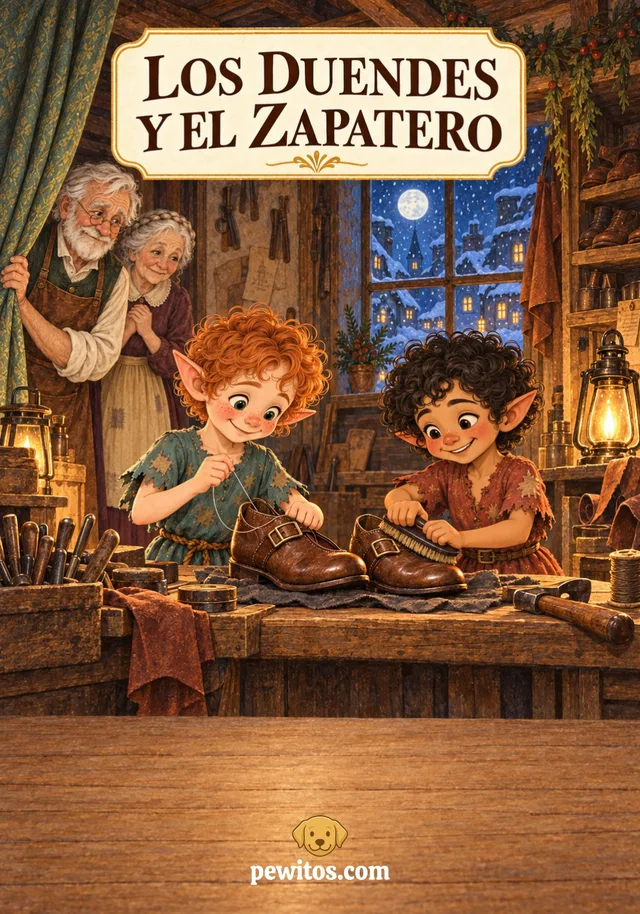
On the chosen night, they left pieces of leather on the bench, put out the lamp, and hid behind the curtain. Outside, the snow crunched. Inside, only the clock could be heard.
At midnight, the door opened only a hand's width. Two tiny elves entered: one with copper curls and a teal tunic; the other with dark curls and a rust-colored tunic. Barefoot, they leaped onto the bench and divided the tools.
The Teal Elf stitched with quick, even seams. The Rust Elf pegged the soles and polished the leather until it shone. They worked, laughed softly, and passed each tool at exactly the right moment.
From behind the curtain, the couple saw the patched tunics and bare feet on the cold wood. The shoemaker squeezed his wife's hand. Those little craftspeople had returned their future without asking for anything.
When the elves finished and left, his wife whispered, “They gave us a new beginning. Let us give them warmth.” “And shoes worthy of shoemakers,” he added. Before dawn, they had chosen teal and rust cloth.
During the day, she sewed one teal outfit and one rust-colored outfit, with tiny buttons and sturdy seams. He cut miniature soles and made two pairs of shoes. Every measurement recalled one of their helpers.
That night they left no leather. On the bench they arranged the two outfits and the two tiny pairs of shoes. Then they put out the lamp and hid again, holding their breath.
The elves arrived, saw the gifts, and dressed at once. The Teal Elf raised his shoes; the Rust Elf spun in his coat. “Now we are elegant shoemakers!” they sang, and danced on the bench until the clock struck one.
The elves danced to the door and disappeared along the snowy street. They did not return. But the shoes they had made brought new orders, and the couple filled the workshop again with their own work.
From then on, the shoemaker and his wife set aside part of everything they earned for anyone who needed help. When a girl arrived with worn-out shoes, they offered her a sturdy pair. Work had changed their lives; gratitude now warmed another.